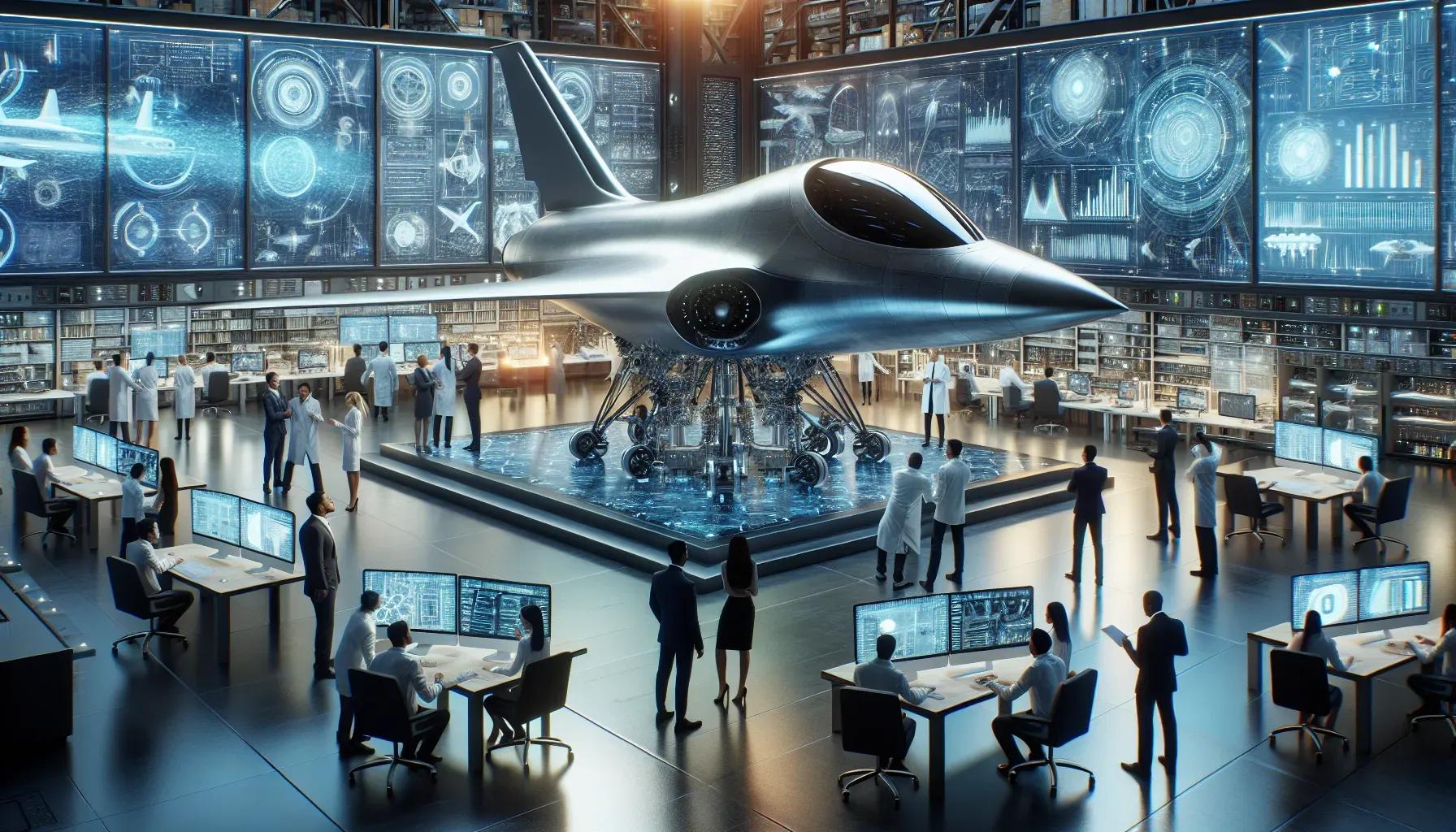

Welcome to the fascinating world of aeronautics, where research and design innovations are constantly pushing the boundaries of what's possible. This blog post will take you on a journey through the latest developments in aeronautics research and design, showcasing the ingenuity and creativity of scientists and engineers in this exciting field.
"The Evolution of Aeronautics Research"
Aeronautics research has come a long way since the Wright brothers' first flight in 1903. Today, it encompasses a wide range of disciplines, from aerodynamics to materials science, and from propulsion systems to flight control technologies.
The field of aerodynamics, for instance, has seen significant advancements in recent years. Researchers are now able to simulate complex airflow patterns using supercomputers, leading to more efficient and safer aircraft designs.
Materials science is another area where aeronautics research is making significant strides. The development of lightweight, high-strength materials is crucial for improving the performance and fuel efficiency of aircraft.
In the realm of propulsion systems, researchers are exploring a variety of innovative concepts, such as electric propulsion and hybrid-electric propulsion. These technologies have the potential to revolutionize the aviation industry by reducing its environmental impact.
"The Role of Computer Simulation in Aeronautics Design"
Computer simulation plays a critical role in aeronautics design. It allows engineers to test new concepts and designs in a virtual environment before building physical prototypes. This not only saves time and money, but also reduces the risk of failure.
One of the key tools in aeronautics design is Computational Fluid Dynamics (CFD). CFD is a branch of fluid mechanics that uses numerical methods and algorithms to solve and analyze problems involving fluid flows. It is widely used in aeronautics to predict the aerodynamic performance of new aircraft designs.
Another important tool is Finite Element Analysis (FEA). FEA is a computerized method for predicting how a product reacts to real-world forces, vibration, heat, fluid flow, and other physical effects. It is used in aeronautics to analyze the structural integrity of aircraft components.
"Emerging Technologies in Aeronautics Research and Design"
A number of emerging technologies are set to transform the field of aeronautics research and design. These include additive manufacturing (or 3D printing), artificial intelligence (AI), and unmanned aerial vehicles (UAVs).
Additive manufacturing is revolutionizing the way aircraft parts are made. It allows for the creation of complex geometries that are impossible to achieve with traditional manufacturing methods. This leads to lighter, stronger, and more efficient aircraft components.